How Much Does a Small Business Website Cost in 2026?
From a free builder to five figures. What each price buys, what a site costs to run after launch, and where our packages sit in the market.
A small business website can cost nothing or tens of thousands of dollars, and both numbers are honest. The spread comes from who does the work, how much of it is custom, and what the site has to do after someone lands on it. This guide puts real ranges on each option, names where every number comes from, and shows where our own packages sit.
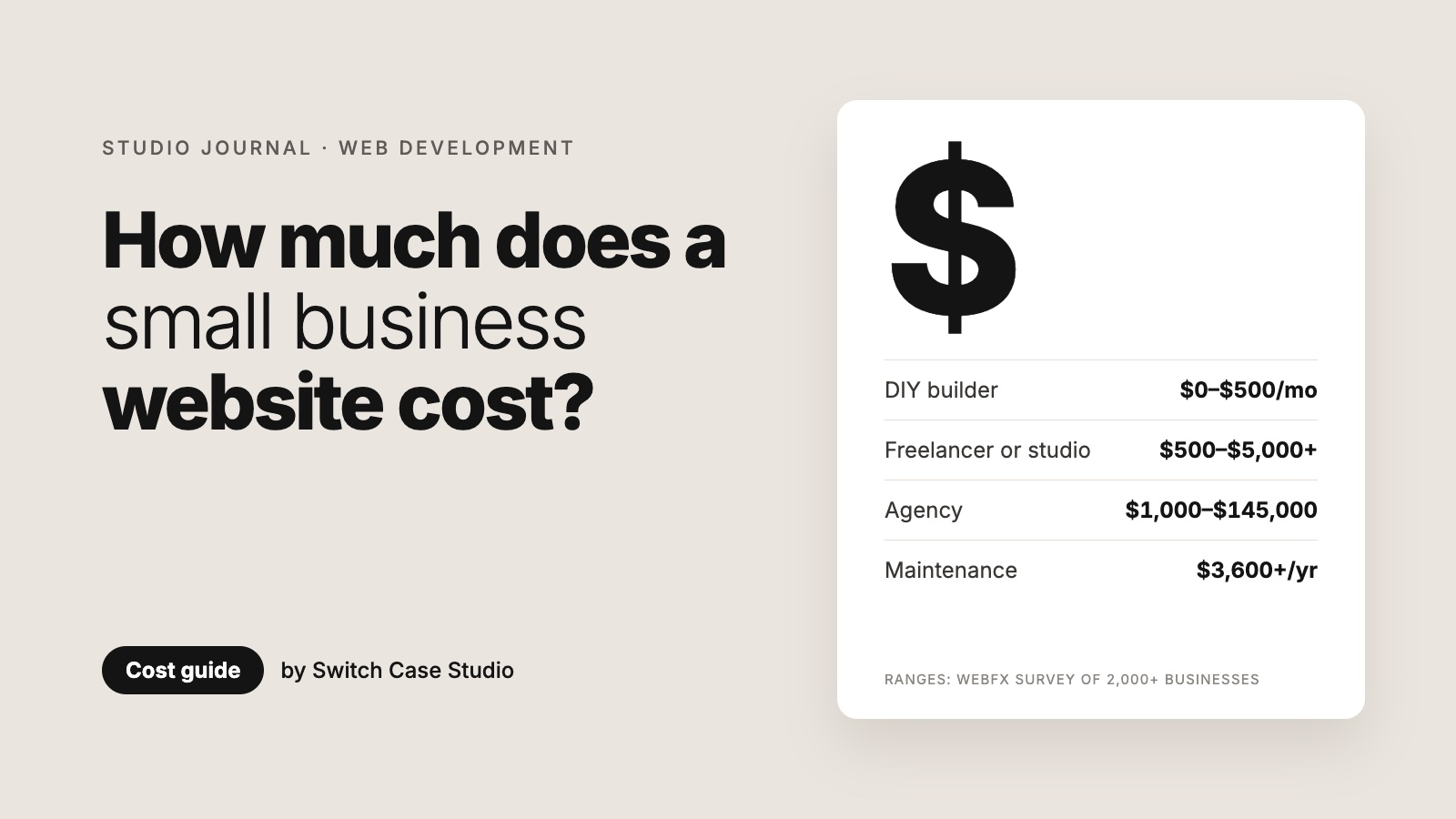
The largest published sample is a survey by WebFX of more than 2,000 businesses. It puts a basic small business site at $0 to $500 with a DIY website builder, and $500 to $5,000 or more when a freelancer or agency designs it. Across every kind of site built by an agency or freelancer, its range runs from $1,000 to $145,000. WebFX sells web design itself, so read those figures as one vendor's view of the market. They are still the best sourced numbers available.
The short answer
- DIY website builder: free to about $500 a month on WebFX's figures. You do the design, the writing and the setup yourself.
- Freelancer or small studio: $500 to $5,000 or more for a small business site, the professional range in the same WebFX survey.
- Agency: from about $1,000 into six figures. The top of that range is large custom builds; a five-page brochure site sits near the bottom.
- Online store: add the platform. Shopify's plans run $29, $79 and $299 a month when billed yearly, and its Basic plan charges card fees from 2.9% + 30¢ per sale.
- Running the site: hosting, domain, updates and edits. WebFX puts ongoing maintenance from an agency or freelancer at $3,600 to $50,000 a year.
What actually moves the price
Two quotes for "a website" can differ by ten times and both be fair, because they describe different work. Five things decide most of the gap.
- Page templates. Ten service pages that share one layout cost far less than ten pages that each need their own design. Ask how many distinct page types the quote covers.
- Custom design or a theme. A theme gets you a decent site fast. A custom design is drawn around your business, your content and your customers, and it takes longer to make.
- Who writes the words. Copy is easy to leave out of a quote. If you are writing it yourself, the project waits on you; if the studio writes it, that is real work and should be priced.
- What the site connects to. Booking, a CRM, payments, a newsletter, a quote form that lands in a spreadsheet. Each connection is a small project with its own testing.
- Selling online. A cart, product pages, tax, shipping and checkout turn a website into a store, and the platform fees above start the day it opens.
The costs that come after launch
The build is the number people compare, and the running cost is the number they live with. WebFX lists the pieces: hosting from $2 to $1,000 a month, and maintenance from $5 to $5,000 a month depending on what is included. That range is wide because "maintenance" means different things to different people.
- Hosting and the domain: where the site lives and its address. Make sure the domain is registered in your name, whoever pays for it.
- Security and updates: plugins, themes and the server itself need patching. A WordPress site that nobody updates is a liability within a year.
- Backups: daily or weekly copies you can restore from, tested at least once.
- Edits: new photos, a price change, a new service page. Ask how many hours a month the plan covers and what an extra hour costs.
- Reporting: a short note on uptime, speed and anything that broke, so you are not the one who finds it.
Builder, freelancer, studio or agency
A builder makes sense when the budget is close to zero and you have the time to do the work. A freelancer is often the best value for a small site, with the risk that one person is your whole support plan. A small studio sits between: a team you can reach, prices closer to a freelancer's than an agency's, and usually the same people from the first call to launch. An agency earns its fee on large, multi-department projects where coordination is half the work.
Compare what each quote includes, line by line, before you compare the totals.
What we charge
Our prices are published, and each one is a fixed price for a defined scope. Every build is a custom design, and from the Simple Website up the first year of hosting and domain registration is included.
- Landing Page, $800: one custom page built around a single goal, with SEO essentials and a fast load.
- Simple Website, $1,500: up to five pages, a gallery, basic SEO, and a year of hosting and domain registration.
- Business Bundle, $2,500: up to ten pages, a content management system, a contact form, Google Analytics, and a year of hosting and domain.
- Growth Suite, $5,000: unlimited pages, e-commerce with checkout, a database, custom forms and advanced SEO.
- Care plans, $75, $125 or $150 a month: hosting, backups, updates, monitoring and monthly edit hours, from shared hosting to your own server.
The builds sit inside the $500 to $5,000+ range WebFX reports for a professionally designed small business site. The care plans come to $900 to $1,800 a year, under the $3,600 floor of its maintenance range, because they cover hosting, updates and a few hours of edits, with a fixed scope.
What the money buys shows up in the numbers. When we rebuilt Florida Green Improvements, the homepage dropped from 29,834 KiB to 1,839 KiB on mobile and its main content painted in 3.46 seconds instead of 11.62. Renewed Bodyworks went from a site Google was not allowed to index to nine pages Google can index, listed in a sitemap, with all eight services priced.
Three example budgets
- A new solo practice that needs to be found and contacted: our Simple Website at $1,500, with the first year of hosting and domain included. From year two, Starter Care at $75 a month, $900 a year, with the domain renewal billed at cost.
- A growing service business with a team and a booking flow: the Business Bundle at $2,500, then Growth Care at $125 a month, $1,500 a year, for staging, daily backups and up to three hours of edits a month.
- A maker selling online on a platform: Shopify's Basic plan is $29 a month billed yearly, $348 a year, before card fees. At 2.9% + 30¢, a $50 sale pays $1.75 in fees. A designed store on top of that is a build cost, like any other site.
How to compare two quotes
- How many distinct page designs does this cover, and what does one more cost?
- Who writes the copy, and is that in the price?
- Who owns the domain, the code and the content when the project ends?
- What is included in the first year of hosting, and what does year two cost?
- How fast will the homepage load on a phone, and how will you measure it?
- What does a small change cost three months after launch?
A quote that answers all six in writing is easier to trust than a lower total that answers none. If you want to see the line items for ours, the Web Development page lists every package side by side.
See the Web Development packagesPublished prices, from $800